The Role of Satellite Communications in Disaster Recovery

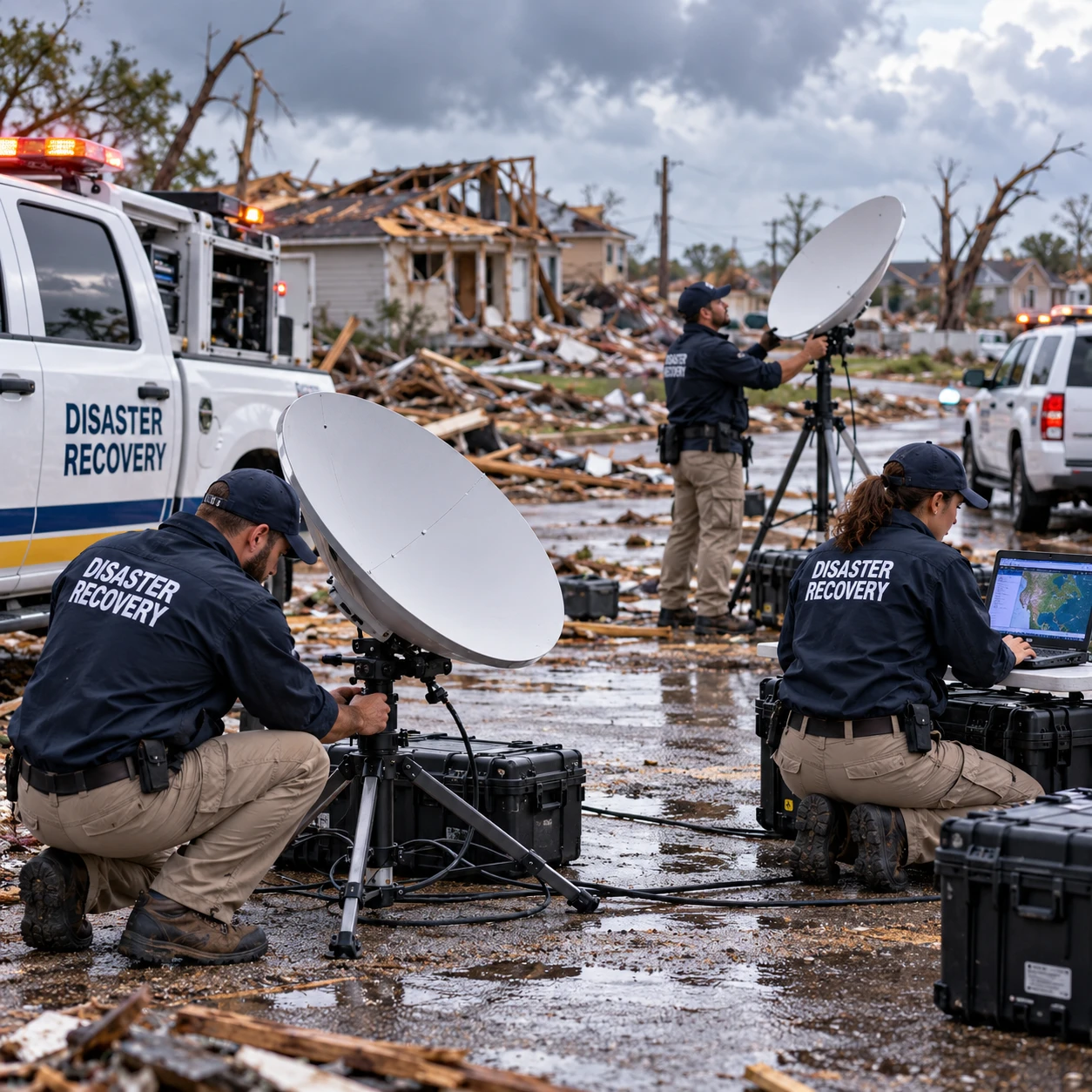
When a hurricane, wildfire, earthquake, or flood damages communications infrastructure, responders need reliable ways to share information and coordinate work. Satellite communications can connect teams and communities when local cellular, fiber, or microwave networks are disrupted. Their value depends on planning, available power, equipment, coverage, and capacity; satellite service is an important part of recovery, not a guarantee of uninterrupted connectivity.
Why communication networks fail during disasters
Terrestrial communication networks can fail when disasters damage sites, interrupt power, or overload surviving connections. Satellite communications can offer an alternate route, but they do not prevent those local failures or remove the need for resilient ground infrastructure.
Cellular service depends on a chain of working components: antennas and base stations, backhaul links, power systems, and core network facilities. Floodwater can disable equipment or cut fiber routes, while earthquakes may damage towers and utility lines. Wildfires and high winds can destroy sites or make them inaccessible to repair crews.
Power loss is often a critical weak point. A network site may be physically intact but unavailable if batteries run down and generators cannot be refueled. Even when some infrastructure remains operational, heavy demand from residents, public agencies, and responders can congest networks and make voice calls or data sessions unreliable.
These problems can compound. A damaged backhaul route may isolate a functioning cell tower; a power outage may affect both the tower and nearby internet equipment. Satellite links can bypass some damaged terrestrial routes, but they still rely on functioning terminals, power, provider networks, and suitable satellite coverage.
How satellite communications restore connectivity
Satellite communications restore connectivity by sending data between a ground terminal and a satellite, then onward through a gateway or network connection. This can link a disaster site to the wider internet or connect field teams to an agency network without relying on local terrestrial backhaul.
A portable terminal might provide internet access at an emergency operations center, shelter, or temporary medical site. Responders can use that connection for mapping, incident reports, logistics, and coordination with teams outside the affected area. Depending on the service and configuration, satellite links can also support voice calls, messaging, and data exchange.
LEO and GEO satellites serve different operating needs. Low Earth orbit (LEO) satellites travel much closer to Earth than geostationary (GEO) satellites. LEO services can offer lower latency, which is useful for interactive applications, but may require a clear view of the sky and depend on service coverage, terminal availability, and network capacity. GEO satellites appear fixed over a region and can provide broad coverage from a stable position, though the longer signal path typically means higher latency.
Neither orbit type is a universal solution. Local terrain, weather, obstructions, service plans, and the condition of the provider’s ground infrastructure can affect availability. Satellite communications work best when agencies know in advance what service is available at the incident location and how it will connect to their systems.
Satellite services and equipment used in recovery
Satellite internet, VSAT, and portable satellite terminals provide different ways to establish emergency connectivity. The right choice depends on how quickly a link must be set up, how many people will use it, and what power and coverage are available.
Satellite internet provides broadband access through a satellite service and a user terminal. A compact terminal may suit a mobile field team or temporary site; a fixed installation can support an operations center or facility that needs a more permanent backup. Performance varies by provider, location, plan, network load, and the view between the terminal and satellite.
VSAT, or very small aperture terminal, describes a satellite communications system that uses a small ground antenna to connect to a satellite network. VSAT is often used for fixed sites, including remote facilities and emergency coordination locations. Some systems can be transported and installed in the field, but antenna alignment, configuration, and integration may require trained staff.
Emergency equipment may include:
- A satellite terminal, antenna, modem, and any required mounting or cabling.
- A router or Wi-Fi access point to share the connection among authorized users.
- Battery storage, a generator, or another compatible power source.
- Configured devices, credentials, and procedures for connecting to agency applications.
A satellite link can become a bottleneck if too many users share limited capacity. Set priorities for essential traffic, such as operational voice, safety updates, and incident data, before routine browsing or large file transfers.
Who relies on satellite connectivity after a disaster?
Emergency responders, public agencies, utilities, businesses, and affected communities use satellite connectivity to communicate when local networks are damaged or inaccessible. Their needs differ, so access and capacity should be assigned according to the work each group must perform.
Fire, medical, search-and-rescue, and law-enforcement teams may use satellite links to exchange situation reports, coordinate field operations, and reach dispatch or command staff. A connection can help when crews work beyond surviving cellular coverage, though radio systems and other established emergency channels remain important.
Government agencies and emergency operations centers can use satellite internet to access records, coordinate logistics, and communicate with regional or national offices. Utilities may connect repair teams with control centers to report damage and manage restoration. Businesses can use backup connectivity to support critical operations, payment systems, and communications with suppliers.
For residents, satellite connectivity may help restore access to information, public services, and contact with family when local broadband or mobile networks are unavailable. Community access points require careful management: clear instructions, safe equipment placement, user support, and fair sharing of limited bandwidth. A single terminal serving a large shelter may not provide the same experience as a dedicated connection for a response agency.
Satellite and terrestrial networks: complementary roles
Satellite and terrestrial networks work best together: satellite links can provide backup connectivity or reach isolated areas while cellular, fiber, and microwave systems are repaired. Satellite service is not a full replacement for terrestrial networks, which usually support dense populations and large volumes of local traffic.
Satellite connectivity can bypass damaged local backhaul and provide a connection at a temporary site. Terrestrial networks, when operational, often offer convenient access through existing phones and infrastructure. A resilient communications plan uses each where it is most effective, with alternate routes available for critical services.
Redundancy means more than owning a spare terminal. The backup path should avoid the same likely failure points as the primary connection. For example, a satellite terminal still needs power, a clear deployment location, trained operators, and a way to connect securely to the organization’s network. If all systems rely on one generator or one inaccessible building, the apparent redundancy may disappear during an incident.
As terrestrial service returns, organizations can shift routine traffic back to restored networks and reserve satellite capacity for remote teams or remaining dead zones. This reduces pressure on limited satellite bandwidth while keeping an alternate route available if repairs are incomplete or further damage occurs.
Planning for reliable emergency connectivity
Reliable emergency satellite connectivity requires tested equipment, independent power, confirmed coverage, realistic capacity, and clear deployment and coordination procedures. Planning ahead is what turns satellite equipment into a usable recovery link.
Start by identifying the sites and users that need connectivity, the applications they depend on, and the minimum service required. Confirm that the satellite provider covers those locations and that the service plan allows the intended use. Ask about terminal compatibility, network access, support arrangements, and any limits on data or priority traffic.
Next, prepare equipment for actual field conditions. Keep terminals, cables, mounting hardware, and spare parts together; label components; and document startup, alignment, and troubleshooting steps. Test the full setup regularly, including the router, agency applications, and power source. A terminal that powers on is not proof that staff can reach the systems they need.
Plan power and placement with equal care. Estimate the equipment’s consumption and the time it must operate, then match batteries or generators to that requirement. Check for a suitable view of the sky, safe mounting, weather exposure, and distance from the users who will share the connection. Trees, buildings, debris, or unstable sites can obstruct or complicate deployment.
Finally, coordinate with emergency management, service providers, neighboring agencies, and local network operators. Agree on who deploys each terminal, who manages access, and which communications take priority. Satellite links have real constraints: congestion, limited capacity, power needs, obstructions, setup requirements, and provider or gateway disruptions can all affect service. Planning for those constraints helps teams use satellite communications as a dependable layer in disaster recovery while terrestrial networks are restored.