Comparing Satellite Internet vs. Fiber Optic vs. 5G: Which Connectivity Option Is Best?

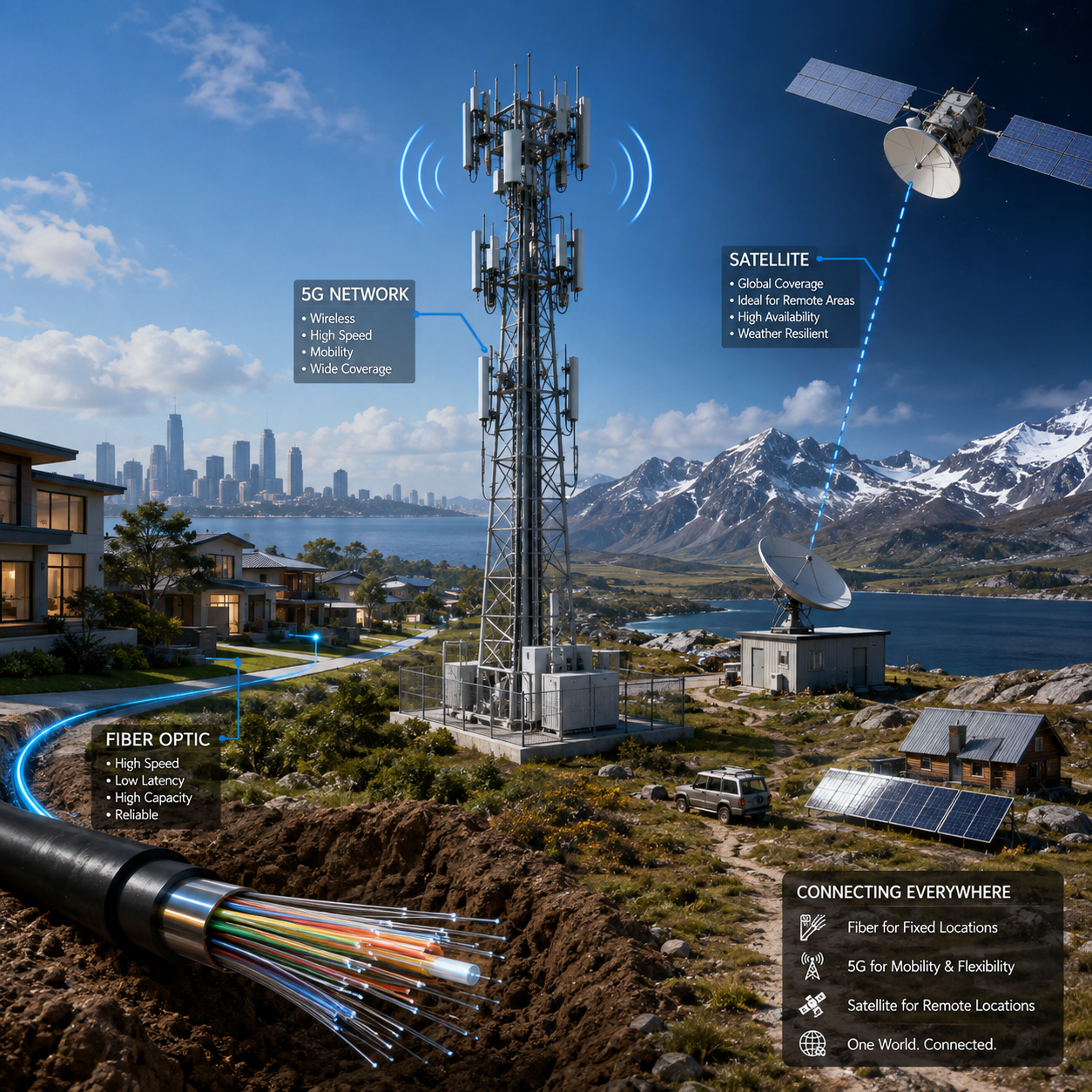
Choosing between satellite internet, fiber optic broadband, and 5G fixed wireless access depends on more than the advertised download speed. Location, latency, coverage, installation time, data policies, weather exposure, and the consequences of an outage all matter.
Fiber is usually the strongest choice where a dependable physical network is already available. 5G can deliver fast wireless access in areas with suitable mobile coverage, while satellite internet and VSAT extend connectivity to rural, offshore, temporary, and difficult-to-reach locations. The right decision starts by matching the technology to the job.
How Satellite Internet, Fiber Optic, and 5G Work
Satellite internet sends data between a user terminal and an orbiting satellite, while fiber optic broadband carries signals through glass strands and 5G uses radio links between devices and cellular network equipment. These connection methods determine where service can be deployed and how it behaves under load.
Fiber optic broadband uses light to transmit data through underground, aerial, or building-level cables. Because the path is dedicated physical infrastructure, fiber typically offers consistent capacity, strong upload performance, and very low latency. Its limitation is geographic: a provider must build and maintain the network along the route to the customer.
5G fixed wireless access connects a home or business router to a nearby 5G cell site. It can avoid the final cable connection to a building, making deployment faster than fiber in some neighborhoods. Performance depends on spectrum, tower capacity, distance, building materials, terrain, and line of sight. A strong 5G signal does not automatically mean unlimited capacity during busy hours.
Satellite internet uses a dish or electronically steered terminal to communicate with a satellite. Geostationary satellite systems cover very large areas but introduce substantial signal distance and latency. Low Earth orbit services reduce that distance and can provide a more responsive experience, although availability, terminal requirements, congestion, and service policies vary by provider.
VSAT, or very small aperture terminal, is commonly used for managed satellite communications at remote sites, ships, aircraft, field operations, and enterprise facilities. VSAT services may provide controlled bandwidth, monitoring, service-level options, and network management that differ from residential satellite plans.
Performance Comparison: Speed, Latency, and Capacity
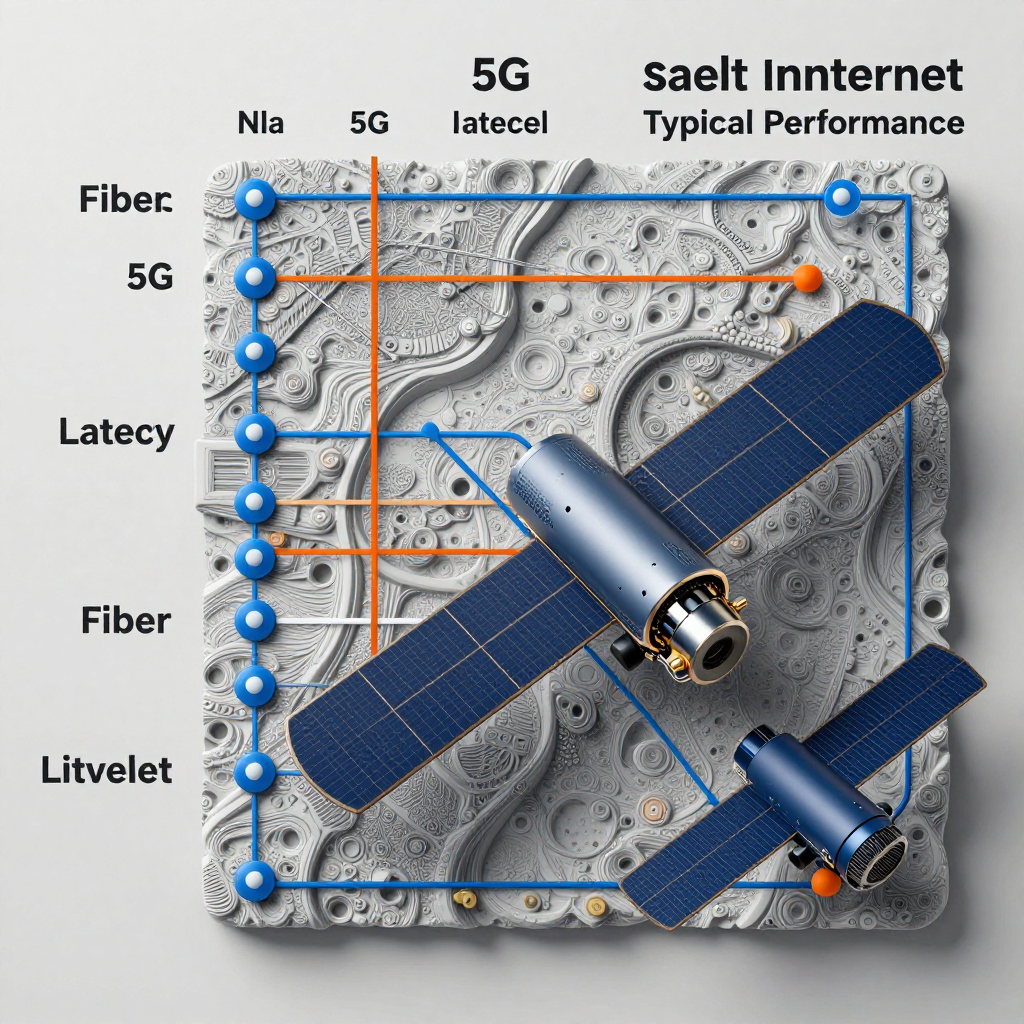
Fiber optic broadband generally delivers the lowest latency and the most predictable capacity; 5G can be fast with moderate latency, while satellite performance varies widely by orbit, network design, and congestion. Advertised speeds are useful, but they do not describe the complete user experience.
| Factor | Fiber optic | 5G fixed wireless | Satellite internet |
|---|---|---|---|
| Download and upload | Often high and symmetrical or near-symmetrical | Can be high, but varies by signal and cell load | Can support broadband, with upload often more limited |
| Latency | Usually lowest | Usually moderate | Higher on geostationary systems; lower on many LEO systems |
| Capacity | Strong and scalable where built | Shared among users on a cell | Shared across satellite beams and gateways |
| Consistency | Typically predictable | Changes with radio conditions and congestion | Can change with congestion, weather, and network policy |
Latency measures the delay before data begins to travel back and forth. It affects video calls, cloud applications, online gaming, interactive remote control, and financial or industrial systems. Download speed matters for streaming, software updates, and large file transfers, but a fast connection with unstable latency can still feel poor during a video meeting.
Fiber is usually the best option for latency-sensitive workloads and heavy simultaneous use. 5G may perform well for homes, branches, and temporary offices when the local network has spare capacity. Satellite can support video conferencing, cloud access, and business applications, but users should test the specific service rather than assume all satellite connections behave alike.
Data caps and traffic management also affect practical bandwidth. A plan may advertise a high peak rate while applying priority reductions after a usage threshold or during busy periods. Review upload speeds, fair-use terms, prioritization, and business traffic policies before comparing monthly plans.
Coverage, Availability, and Installation Requirements
Fiber requires nearby physical infrastructure, 5G requires usable local radio coverage, and satellite requires a clear view of the sky. Satellite therefore has the broadest reach in places where terrestrial networks are absent, although terrain, regulations, and service footprint still matter.
Fiber is highly practical in dense urban areas, established suburbs, business districts, and industrial parks. Installation may involve a street connection, building entry work, permits, and an appointment. Rural extensions can require long construction timelines because providers must justify the cost of poles, ducts, backhaul, and maintenance.
5G fixed wireless access is often attractive where a nearby tower already serves the area. A technician may position an outdoor receiver for better signal quality, or a customer may install an indoor gateway. Walls, foliage, hills, and low-frequency or high-frequency spectrum choices can produce very different results between neighboring addresses.
Satellite internet works in many rural and remote locations without waiting for a cable route. The terminal needs a suitable mounting position and a largely unobstructed view toward the relevant part of the sky. Trees can grow into the signal path, and a roof or pole installation may require grounding, structural checks, and professional installation.
- Urban: Fiber is usually preferred, with 5G as a useful alternative where wired service is unavailable or slow to install.
- Suburban: Compare actual fiber availability with 5G signal quality and local cell capacity.
- Rural: Satellite, 5G, fixed wireless, and limited fiber should be evaluated address by address.
- Remote or offshore: Satellite and VSAT are often the practical primary connection, sometimes supported by cellular or microwave links.
- Mobile operations: Satellite terminals, cellular 5G, and multi-network routers can support vehicles, vessels, aircraft, and field teams.
Reliability, Weather, Congestion, and Redundancy
Reliability depends on the entire connection path, not only the access technology. Fiber avoids most radio interference but can be disrupted by construction damage, power failures, flooding, or a cut in shared backhaul. 5G can be affected by tower outages, power loss, interference, and congestion.
Satellite links may experience rain fade, especially at higher frequencies and during intense storms. Snow accumulation, ice, dish movement, and obstructions can also reduce service. Modern terminals and network designs manage many short disruptions, but a critical site should still plan for weather-related degradation rather than treat satellite as infallible.
Congestion is another key distinction. Fiber networks generally provide more consistent performance, though provider oversubscription and backhaul limits remain possible. 5G shares radio capacity across a cell, so evening demand or a crowded event can reduce throughput. Satellite capacity is shared across beams and gateways, and providers may prioritize traffic under their data-management policies.
For important operations, use a simple resilience framework: different path, different power, different failure. A fiber primary paired with 5G may fail if both depend on the same local power or backhaul route. Adding satellite or VSAT can create genuinely diverse access, especially for remote facilities, emergency response, energy sites, and maritime operations.
Cost, Equipment, Data Policies, and Scalability
Fiber often offers the best long-term value for high-volume fixed use, 5G can reduce installation complexity, and satellite may cost more per unit of capacity but remain economical when terrestrial construction is impractical. Compare total cost rather than the monthly access charge alone.
Fiber customers may pay an installation fee, modem or optical network terminal charge, router cost, and business service activation. Construction fees can be significant for an isolated property. Once installed, fiber usually scales well through higher service tiers, dedicated circuits, or additional wavelengths and backhaul capacity.
A 5G setup typically requires a cellular gateway or outdoor receiver. Equipment may be included, leased, or purchased. The main financial risk is choosing a plan based on a short speed test when performance falls sharply at busy times. Confirm expected service levels, data allowances, public IP options, and whether external antennas are supported.
Satellite requires a dish or terminal, mounting hardware, power, and sometimes a clear installation route. Managed VSAT adds costs for engineering, monitoring, service support, and reserved capacity. These expenses can be justified where downtime, travel, or terrestrial construction would cost more than the link itself.
Check these terms before signing:
- Monthly data allowance, fair-use threshold, and overage policy
- Traffic prioritization during congestion
- Upload speed and business-class service options
- Equipment ownership, replacement, and maintenance responsibility
- Public IPv4, IPv6, VPN, and inbound-access support
- Contract length, installation lead time, and service-level commitments
Which Option Is Best for Different Connectivity Needs?
The best connectivity option is the one that meets the site’s performance, availability, and resilience requirements at an acceptable total cost. Use the following decision guide instead of ranking technologies in isolation.
Residential homes
Choose fiber when it is available at a reasonable installation cost and the household needs reliable streaming, gaming, remote work, and multiple simultaneous users. Choose 5G when the signal is strong and the plan has suitable data terms. Satellite is a strong option for rural homes outside wired and dependable cellular coverage, particularly when the household can accept higher latency or variable weather performance.
Small businesses and branch offices
Fiber usually provides the most predictable primary connection for cloud software, voice, payment systems, and large uploads. 5G can serve as rapid primary access or failover. Satellite or VSAT is valuable for remote branches, construction sites, agricultural facilities, and locations where a wired circuit would take months to deliver.
Enterprise and mission-critical networks
Enterprises should assess diverse carriers, service-level agreements, managed routers, monitoring, and automatic failover. Fiber may carry normal traffic, 5G may handle local backup, and satellite or VSAT may preserve essential communications when terrestrial routes fail.
Emergency response and temporary deployments
Satellite terminals can be deployed where local infrastructure is damaged or absent. 5G is useful when commercial networks remain operational, while fiber is appropriate for a temporary facility with a suitable nearby connection. Power planning matters as much as bandwidth: include batteries, generators, or mobile power systems.
Maritime, aviation, and remote industrial operations
Satellite communications are central to offshore platforms, vessels, aircraft, and isolated industrial sites. VSAT can provide managed connectivity, while cellular 5G may complement it near ports, shorelines, or populated areas. The design should account for mobility, antenna tracking, coverage corridors, weather, and operational data priorities.
When a Hybrid Connectivity Strategy Makes Sense
Hybrid connectivity makes sense when one link cannot provide the required combination of speed, coverage, uptime, and deployment flexibility. A hybrid network combines fiber, 5G, satellite, VSAT, or another access method through a router, SD-WAN platform, or managed network service.
A common design uses fiber as the primary link, 5G as automatic failover, and satellite as a tertiary connection for extended outages or geographically isolated sites. A rural business might reverse that order: satellite or VSAT as primary access, 5G as a lower-latency option when available, and a future fiber build as the long-term upgrade.
Hybrid connectivity can also divide traffic. Latency-sensitive voice and interactive applications may use fiber or 5G, while backup replication, telemetry, and essential management traffic use satellite. Policies can reserve satellite bandwidth for priority users rather than allowing routine downloads to consume the entire link.
Before deployment, document the failure sequence. Test automatic switching, DNS behavior, VPN reconnection, public addressing, battery runtime, and provider support. A backup link that requires someone to drive to a remote site and connect a cable is a contingency, not dependable redundancy.
For authoritative background on broadband technologies and network performance terminology, consult the U.S. Federal Communications Commission and the NASA communications resources relevant to satellite systems.
Frequently Asked Questions
Is satellite internet faster than 5G?
Satellite internet is not automatically faster than 5G. A strong 5G fixed wireless connection may provide higher throughput and lower latency, while satellite is often more widely available beyond terrestrial coverage. Compare the specific plan, signal conditions, congestion, and data policy.
Why does fiber usually have lower latency than satellite internet?
Fiber usually has lower latency because data travels through a short terrestrial cable path rather than traveling to orbit and back. Low Earth orbit satellite systems can reduce the gap, but fiber generally remains more predictable for interactive applications.
Is satellite internet suitable for business and remote sites?
Yes. Satellite internet and managed VSAT can support remote offices, field operations, offshore facilities, telemetry, cloud access, and business continuity. Select a service with appropriate bandwidth, technical support, traffic priority, equipment, and redundancy.
Can 5G or satellite internet serve as a fiber backup?
Yes. 5G is often a practical fiber backup where cellular coverage and capacity are strong. Satellite provides a more geographically independent backup for sites where terrestrial and cellular failures may occur together, although weather, latency, and data limits must be planned for.
What should users consider when choosing between satellite, fiber, and 5G?
Compare availability, download and upload performance, latency, reliability, weather exposure, congestion, installation requirements, equipment, data caps, total cost, scalability, and the consequences of downtime. Then test the actual service at the site whenever possible.