Understanding Satellite Internet: How It Works and Who It’s For

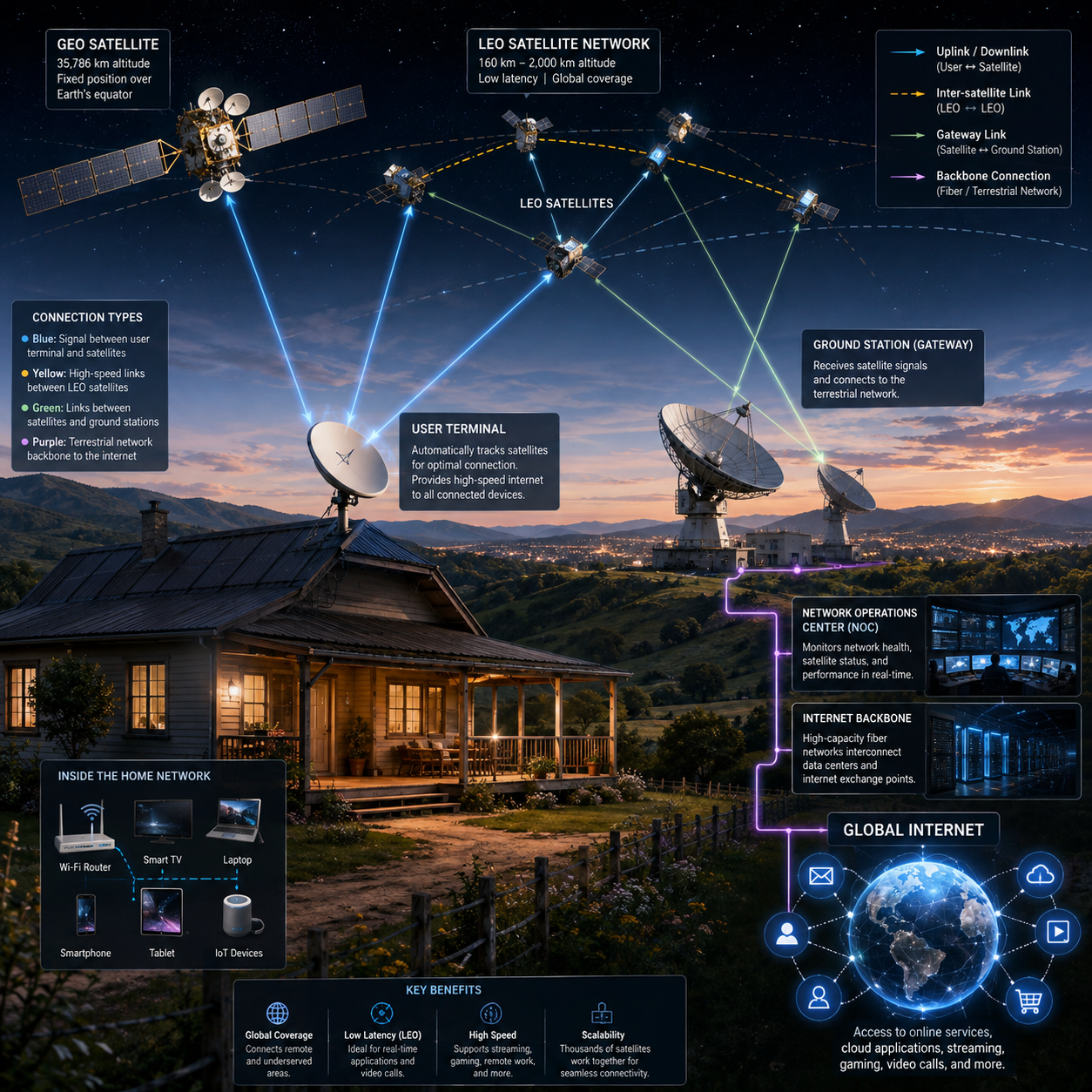
Satellite internet delivers broadband connectivity through radio signals exchanged between a user terminal, a communications satellite, and a ground station. It can reach homes, businesses, ships, aircraft, field teams, and remote facilities that lack dependable fiber, cable, fixed wireless, or mobile coverage.
The technology is not one uniform service. Performance depends on the satellite’s orbit, network design, service plan, weather, congestion, and the quality of the installation. Understanding those differences helps you decide whether satellite internet is a practical primary connection, a backup link, or a specialized VSAT service.
What Is Satellite Internet?
Satellite internet is a broadband service that sends data between a customer’s location and the internet through a communications satellite rather than a local terrestrial cable or radio tower. Its greatest value appears where conventional infrastructure is unavailable, expensive to extend, or vulnerable to disruption.
A subscriber typically uses an outdoor user terminal, often called a satellite dish, pointed toward a satellite. The terminal connects to an indoor modem or router, which supplies internet access to computers, phones, cameras, and other devices.
Unlike fiber or cable, satellite internet does not require a physical line running from the customer’s property to a nearby network node. That makes it useful for rural homes, mines, construction sites, maritime operations, disaster zones, and remote offices. However, the absence of local cabling does not mean the service works everywhere. The terminal still needs a suitable view of the sky, electrical power, compatible equipment, and an operator with coverage in that region.
Satellite broadband also differs by orbit. Geostationary Earth orbit (GEO) systems have traditionally supported wide-area coverage, while Low Earth orbit (LEO) networks use many closer satellites. Medium Earth orbit (MEO) services occupy the space between them and are used for selected communications and connectivity applications.
How Satellite Internet Works
To use satellite internet, your data travels from a device to a user terminal, up to a satellite, down to a ground station, across the internet backbone, and back through the satellite network. The return path follows the same stages in reverse.
- Your device sends a request. When you open a website or join a video call, your phone or computer sends packets to the local router and modem.
- The user terminal transmits the signal. The satellite dish converts the modem’s electrical data into a radio signal and aims it at the communications satellite.
- The satellite relays the traffic. Depending on the system, the satellite either forwards the signal to a ground station or routes it through links to another satellite before reaching the ground.
- The ground station connects to terrestrial networks. A ground station, also called a gateway, links the satellite network with fiber backbones, data centers, internet exchange points, and destination servers.
- The response returns to you. The requested web page, video stream, or application data travels from the server to the ground station, through the satellite, and back to the user terminal.
This path explains why satellite internet can work far from cities while also introducing delay. A request may cross several long radio links before the server responds. The number of hops, routing architecture, and satellite orbit all influence latency, the time between sending data and receiving a response.
Latency is separate from bandwidth. Download and upload speeds describe how much data a connection can transfer over time. Latency describes how quickly communication begins. A connection may download a large file efficiently yet feel slow when loading many small web elements, controlling a remote system, or playing a fast-action online game.
For a technical overview of satellite communications and orbital categories, readers can consult NASA and other government space resources.
GEO, MEO, and LEO Satellites Explained
GEO, MEO, and LEO satellites differ mainly by altitude, and that altitude affects coverage area, latency, antenna tracking, and network complexity. GEO satellites cover large regions from high altitude, while LEO satellites reduce signal distance by operating much closer to Earth.
Geostationary Earth orbit
A GEO satellite orbits approximately 35,786 kilometers above the equator and appears fixed over one point on Earth. A dish can therefore remain pointed in one direction, and a single satellite can cover a broad geographic footprint.
The compromise is higher latency. A signal must travel a long distance up to the satellite and back to a gateway, sometimes creating noticeable delays in interactive applications. GEO remains useful for broad coverage, broadcast services, remote sites, maritime connectivity, and locations where consistent regional availability matters more than fast response times.
Low Earth orbit
LEO satellites operate at much lower altitudes, commonly hundreds to roughly 2,000 kilometers above Earth. The shorter path can support lower latency, but a LEO network needs many satellites because each spacecraft covers a smaller area and moves across the sky.
LEO terminals may track moving satellites electronically or mechanically. The network must coordinate handoffs as satellites rise and set, and service can depend on constellation capacity, gateway placement, local obstructions, and regulatory approvals. LEO can provide a more responsive experience, though performance still varies by plan and network conditions.
Medium Earth orbit
MEO satellites operate between LEO and GEO. They can offer a middle ground: broader coverage than LEO with potentially lower latency than GEO. MEO systems are less common in consumer satellite internet but can serve enterprise, mobility, and specialized communications requirements.
A simple decision rule helps: choose based on the application, not the orbit’s label alone. Web browsing and basic business tools may work on several architectures. Remote control, real-time collaboration, voice, and interactive cloud applications place greater value on low latency and stable routing.
What Equipment and Services Are Required?
A satellite internet installation generally requires an outdoor user terminal, an indoor modem or router, power, a mounting location, and an activated service plan. Business and mobile deployments may also need monitoring, traffic management, backup power, and professional network support.
The user terminal contains the antenna and radio electronics that communicate with the satellite. The installer places it where trees, buildings, terrain, or other obstructions are unlikely to block the required sky view. A cable then connects the terminal to indoor equipment, although some newer designs combine modem and routing functions.
Before installation, check:
- Whether the provider has service coverage at the exact address or operating area.
- Whether the roof, pole, mast, vessel, vehicle, or ground mount can support the equipment safely.
- Whether the site has reliable electricity and surge protection.
- Whether the network supports the required upload speeds, data allowance, mobility, and public or private addressing.
- Whether local permits, landlord approval, or maritime and aviation certifications apply.
VSAT, meaning very small aperture terminal, describes a class of satellite ground station that commonly supports two-way communications for businesses, government agencies, energy sites, ships, retailers, and remote branches. A consumer satellite plan may prioritize simple self-installation and household use. A business-focused VSAT service may provide a managed router, service-level commitments, centralized monitoring, static IP options, application prioritization, and network integration.
Those added controls cost more and require planning. A VSAT service makes sense when uptime, security, mobility, or multi-site management matters enough to justify professional deployment.
Advantages and Limitations of Satellite Internet
Satellite internet provides exceptional geographic reach and fast deployment, but it trades some responsiveness, installation flexibility, and performance consistency for that reach. The right choice depends on what is available locally and how the connection will be used.
Key advantages
- Broad coverage: Satellite networks can serve remote regions beyond the footprint of fiber, cable, fixed wireless, or cellular towers.
- Rapid deployment: A terminal can often be installed faster than new terrestrial infrastructure can be constructed.
- Location flexibility: Specialized terminals can support temporary sites, mobile operations, vessels, and emergency-response teams.
- Network independence: Satellite can provide backup connectivity when local cables or towers fail, provided the site has power and a usable sky view.
Important limitations
- Latency: GEO systems can feel less responsive than fiber, while LEO generally reduces but does not eliminate delay.
- Weather sensitivity: Heavy rain, snow, ice, or dense atmospheric conditions can weaken radio signals, especially at higher frequencies.
- Capacity and congestion: Speeds may change when many subscribers share regional network capacity.
- Data policies: Some plans apply data thresholds, traffic prioritization, or fair-use rules that affect heavy streaming and large downloads.
- Equipment and installation costs: Hardware, mounting, cabling, service visits, and power systems can raise the total cost of ownership.
- Obstructions: Trees and buildings can interrupt service even when the provider officially covers the area.
For example, a rural household may find satellite internet more practical than waiting years for fiber expansion. A remote engineering team may value a managed VSAT link for secure access to company systems. In both cases, users should test application behavior during busy periods and review the provider’s data and outage policies rather than relying only on advertised peak speeds.
Who Is Satellite Internet Best For?
Satellite internet is best for users whose locations lack reliable terrestrial broadband or who need connectivity in temporary, mobile, or widely dispersed environments. It is less attractive when affordable fiber or cable offers lower latency and generous capacity at the same address.
- Rural households: Homes outside cable and fiber footprints can use satellite for browsing, education, streaming, cloud services, and everyday communication.
- Remote businesses: Farms, lodges, clinics, research stations, and branch offices can connect staff, payment systems, cameras, and cloud applications.
- Field operations: Construction, mining, forestry, energy, and environmental teams can establish links where network infrastructure changes frequently.
- Maritime users: Ships and offshore facilities may use specialized satellite terminals for crew communications, operational data, safety systems, and business traffic.
- Emergency-response organizations: Portable or vehicle-mounted systems can restore communications after terrestrial networks are damaged.
- Organizations needing backup connectivity: A satellite link can add geographic diversity to a fiber or cellular connection, reducing dependence on one local network route.
Satellite may be a poor fit for applications that require extremely low latency, such as competitive gaming, high-frequency trading, or some forms of real-time remote control. It can still support video calls, streaming, and business applications when the plan provides sufficient capacity and the network is stable, but users should expect interactive performance to vary by orbit and congestion.
How to Decide If Satellite Internet Is Right for You
To decide whether satellite internet is right for you, compare your exact location, applications, reliability requirements, installation conditions, total budget, and available terrestrial alternatives. Use the following checklist before ordering equipment.
- Map your alternatives. Check fiber, cable, fixed wireless, DSL, and mobile broadband at the exact service address. Compare real-world availability, not only regional coverage maps.
- Classify your applications. List ordinary browsing, streaming, video calls, cloud backups, VPN access, cameras, voice services, and any latency-sensitive systems. Separate high bandwidth needs from low-latency needs.
- Inspect the site. Confirm an unobstructed sky view, safe mounting point, cable route, grounding, and dependable power. For vehicles and vessels, verify mobility hardware and operating restrictions.
- Review service terms. Examine upload and download speeds, latency expectations, data allowances, prioritization, installation charges, equipment ownership, support hours, and cancellation rules.
- Price the complete system. Include hardware, professional installation, mounts, cabling, backup power, taxes, maintenance, and any managed VSAT features. A low monthly fee can hide substantial deployment costs.
- Plan for failure. If connectivity supports payments, medical operations, safety, or business continuity, consider a cellular, fiber, radio, or second satellite path where practical.
A useful rule is to choose satellite when reach and deployability outweigh the advantages of local terrestrial broadband. Choose fiber or cable when low latency, high capacity, and predictable indoor installation are available at a reasonable cost. Choose a managed VSAT service when the connection must support remote operations, multiple sites, mobility, security controls, or formal service management.
Frequently Asked Questions
How does satellite internet differ from fiber or cable broadband?
Fiber and cable transmit data through terrestrial networks, usually producing lower latency and stable high capacity where infrastructure exists. Satellite internet reaches locations without that local infrastructure, but signal travel distance, weather, shared capacity, and installation conditions can affect performance.
Is satellite internet available everywhere?
No. Availability depends on the operator’s coverage, licensing, network capacity, terminal type, and the site’s view of the sky. Service may also be restricted for mobile, maritime, aviation, or cross-border use.
Why is satellite internet latency important?
Latency affects responsiveness. High latency can make video calls, VPN sessions, interactive cloud software, remote desktops, and online games feel delayed even when download speeds appear adequate.
Can satellite internet support video calls, streaming, and business applications?
Yes, many services can support these activities when capacity and data policies permit. Video calls need stable two-way performance, while streaming mainly requires sustained download capacity. Business users should test VPNs, voice applications, cloud platforms, and backup systems before switching fully.
What is the difference between satellite internet and VSAT?
Satellite internet is the broad category of internet access delivered through satellites. VSAT refers to a small satellite ground terminal and is often associated with managed business, enterprise, government, maritime, and remote-site communications. A VSAT deployment may include specialized antennas, network monitoring, security, and service guarantees.