The Future of Space-Based Connectivity: Trends to Watch

Space-based connectivity is moving from a specialist solution for remote sites to a central component of modern telecommunications. Satellite internet, VSAT services, mobile networks, and cloud applications are increasingly working together to reach places where fiber and terrestrial cellular infrastructure are unavailable, expensive, or vulnerable.
The next phase will focus on practical outcomes: broader coverage, lower latency, more flexible capacity, resilient communications, and simpler access for end users. Progress will be meaningful, but satellite networks will complement terrestrial infrastructure rather than replace fiber, 5G, or local broadband in every situation.
Why Space-Based Connectivity Is Becoming More Important
Space-based connectivity extends communications beyond the practical reach of terrestrial networks. It supports remote, mobile, underserved, and disaster-affected locations by linking users through satellite constellations and ground stations.
Fiber remains the preferred option where dense, fixed infrastructure is affordable. Cellular networks provide efficient coverage in populated areas. Satellite systems fill the gaps between them. A satellite link can serve an offshore vessel, a temporary worksite, an isolated community, or a disaster zone without waiting for roads, towers, or cables to be built.
This role is becoming more valuable as organizations depend on cloud platforms, real-time monitoring, digital payments, telemedicine, and connected operations. A communications outage can interrupt logistics, energy production, public safety, and business continuity. Satellite connectivity adds a separate path that can operate when terrestrial routes are damaged or congested.
Climate events, geopolitical disruption, and the expansion of remote industries are also increasing demand for resilient networks. The strongest deployments use satellite as one layer in a broader architecture, with automatic failover between fiber, cellular, microwave, and satellite links.
The Rise of Multi-Orbit Satellite Networks
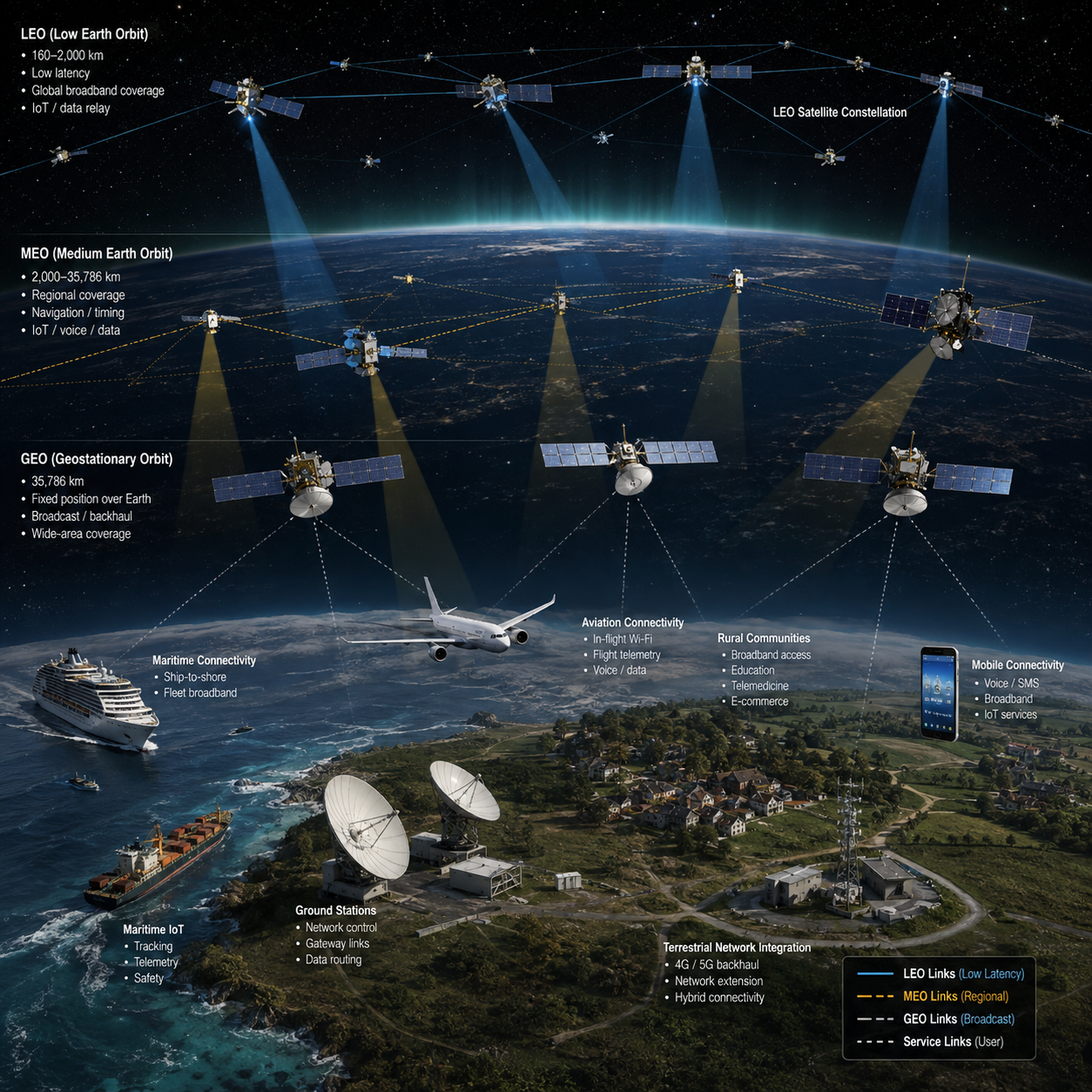
Multi-orbit satellite networks combine LEO, MEO, and GEO systems to balance latency, coverage, capacity, and service continuity. Each orbit has different engineering and commercial strengths, so the most flexible designs use the right layer for each traffic requirement.
| Orbit | Main characteristics | Typical strengths |
|---|---|---|
| LEO | Low altitude, many satellites, shorter signal paths | Lower latency, high-frequency reuse, broadband and mobility |
| MEO | Higher altitude than LEO, fewer satellites required | Regional coverage, balanced latency and capacity |
| GEO | Satellite appears fixed over one region | Wide coverage, stable beams, broadcast and established VSAT services |
Low Earth orbit satellites can reduce latency because signals travel a shorter distance. That makes LEO attractive for interactive satellite internet, video conferencing, cloud applications, and some operational technologies. The trade-off is a large constellation, frequent handovers, complex network management, and a greater dependence on tracking antennas or electronically steered terminals.
Medium Earth orbit satellites occupy a middle position. They can cover broad areas with fewer spacecraft than LEO systems while offering lower latency than GEO. MEO networks may suit regional broadband, mobility, and capacity-focused services where a balance between coverage and responsiveness matters.
Geostationary Earth orbit satellites remain important because one satellite can cover a large geographic footprint and provide a fixed point of communication. GEO is well established for television distribution, government networks, cellular backhaul, maritime services, and enterprise VSAT. Its higher latency can limit highly interactive applications, but stable coverage and mature infrastructure remain powerful advantages.
Network orchestration will increasingly select an orbit according to application needs. A branch office might use LEO for primary internet access, GEO for backup, and cellular where available. That is a service architecture, rather than a simple choice between satellite generations.
Faster, More Flexible Satellite Internet and VSAT Services
Satellite internet and VSAT services are becoming more adaptable through higher-capacity payloads, smarter antennas, software-defined networks, and hybrid terrestrial integration. The objective is to deliver usable capacity where it is needed while controlling equipment and operating costs.
Modern satellites can reuse spectrum through tightly shaped spot beams and frequency planning. Digital payloads can adjust beam resources as demand changes, allowing operators to redirect capacity toward ports, rural regions, emergency areas, or seasonal events. This flexibility matters because demand is rarely distributed evenly across a coverage footprint.
Ground equipment is changing as well. Electronically steered antennas can track moving satellites without a large mechanical dish, supporting vehicles, aircraft, vessels, and rapidly deployable teams. Smaller terminals can simplify installation, although they may involve higher equipment costs, power requirements, or service limitations compared with fixed VSAT antennas.
Virtualization is another important trend. Network functions can run in software, connect with cloud platforms, and integrate with existing security and orchestration tools. A managed VSAT service can therefore become part of a software-defined wide area network, using policy-based routing to send voice, business applications, and bulk data over the most suitable connection.
Hybrid satellite-terrestrial services are especially practical. Satellite can provide coverage and backup while fiber or 5G handles high-volume traffic when available. Organizations should compare the complete service, including terminal installation, contention policies, network monitoring, public IP options, maintenance, and restoration procedures, rather than judging a solution by advertised download speed alone.
Direct-to-Device and Non-Terrestrial Networks
Direct-to-device connectivity allows satellites to communicate with ordinary mobile devices and low-power endpoints, while 5G non-terrestrial networks extend mobile standards into space-based coverage. These services could provide messaging, emergency contact, IoT links, and selected data services beyond terrestrial cellular reach.
Traditional satellite communications usually require a dedicated terminal, dish, or specialized handset. Direct-to-device models aim to use existing smartphones or cellular modules, often through partnerships between satellite operators and mobile network operators. A compatible device may connect through satellite when no terrestrial tower is available, then return to the cellular network when coverage resumes.
The first services are likely to emphasize applications that tolerate limited bandwidth, such as text messaging, location sharing, emergency alerts, asset tracking, and sensor data. Direct satellite broadband for every smartphone remains more demanding because of antenna efficiency, spectrum availability, power consumption, satellite capacity, and regulatory constraints.
The 5G and NTN framework is designed to help non-terrestrial networks work with established mobile architectures. Standards development can improve interoperability between satellites, network cores, user equipment, and operators. It may also make satellite links easier to manage as one element of a broader communications system.
For businesses, the important question is less whether every device will become satellite-connected and more which endpoints benefit from ubiquitous reach. Utility sensors, connected vehicles, maritime equipment, emergency beacons, and remote industrial assets may gain the most from a carefully designed hybrid model.
Key Applications Across Industries
Space-based connectivity supports industries that need coverage, mobility, resilience, or rapid deployment. Its value is highest when terrestrial infrastructure cannot meet geographic or operational requirements on its own.
- Enterprise connectivity: Retail branches, construction sites, financial services, and remote offices can use satellite internet or VSAT for primary access, backup, or temporary operations.
- Maritime communications: Ships, offshore platforms, and fishing fleets require connectivity beyond coastal cellular coverage for crew welfare, navigation support, business systems, and operational data.
- Aviation: Aircraft connectivity depends on reliable links across oceanic and polar routes, with satellite networks supporting passenger services, crew communications, and aircraft operations.
- Rural broadband: Satellite internet can reach dispersed homes and communities without the cost of extending fiber or building dense cellular networks.
- Emergency response: Portable terminals can restore communications after floods, earthquakes, wildfires, or storms when towers and backhaul links are unavailable.
- Government and defense networks: Public agencies use satellite links for continuity, field operations, border regions, and secure communications, subject to procurement and regulatory requirements.
- Energy and logistics: Mines, pipelines, wind farms, shipping routes, and remote warehouses can connect sensors, workers, vehicles, and control systems across large territories.
Use cases differ in their tolerance for latency and interruption. A telemetry sensor may send small packets once an hour, while a control room needs predictable performance and managed failover. Service design must follow the application, not the other way around.
Challenges That Will Shape Adoption
Adoption will depend on solving capacity, regulatory, security, cost, and reliability challenges. Space-based connectivity can expand coverage quickly, but every deployment still depends on spectrum, ground infrastructure, operational support, and sustainable economics.
Capacity management is a persistent issue. A large coverage area does not guarantee unlimited throughput, especially when many users share the same beam. Operators must manage contention, prioritize traffic, and add spacecraft or gateway capacity as demand grows.
Spectrum coordination and licensing can delay deployment across borders. National authorities may impose rules for landing rights, gateway locations, lawful access, data protection, and satellite terminal operation. Organizations with international sites need a provider that can document compliance in each jurisdiction.
Space debris and congestion create long-term operational concerns. Constellation operators need collision-avoidance procedures, tracking capabilities, responsible end-of-life plans, and coordination with other space users. Launch availability and equipment supply also affect deployment schedules and total cost.
Cybersecurity requires attention from the user terminal to the cloud application. Risks include compromised devices, exposed management interfaces, jamming, spoofing, weak identity controls, and insecure remote access. Encryption, segmentation, multifactor authentication, patching, and 24-hour monitoring should form part of the service design.
Reliability has physical limits. Heavy rain can reduce performance at some frequencies, obstructions can interrupt a terminal, and satellite handovers or gateway outages can affect service. Resilience improves when organizations combine diverse paths and test failover before an incident occurs. Guidance from bodies such as the U.S. Federal Communications Commission also illustrates why licensing and space-safety policy matter to connectivity planning.
What Businesses Should Consider Next
Businesses should evaluate satellite connectivity as part of a complete network architecture, using coverage, performance, integration, resilience, and total cost as decision criteria. A short requirements assessment prevents organizations from buying capacity that does not match the operating environment.
A practical evaluation framework
- Map the coverage requirement. Identify exact sites, routes, maritime zones, flight paths, and seasonal changes. Check elevation angles, obstructions, regulatory availability, and indoor or vehicle installation conditions.
- Define application performance. Separate routine internet use from voice, video, cloud software, industrial control, telemetry, and backup traffic. Record latency, jitter, packet-loss, and minimum throughput requirements.
- Choose the right orbit mix. LEO may suit interactive broadband and mobility; MEO can balance regional coverage and latency; GEO may provide stable wide-area service and established VSAT operations.
- Plan redundancy. Decide whether satellite will be primary, backup, or one path in an active hybrid design. Specify automatic failover, restoration targets, and how traffic priorities change during an outage.
- Check integration. Confirm compatibility with SD-WAN, firewalls, identity systems, cloud platforms, monitoring tools, private networks, and existing 5G or fiber connections.
- Calculate total cost. Include terminals, antennas, installation, power, site access, spectrum or licensing charges, managed services, support, replacement equipment, and data overage policies.
- Test the service in real conditions. A pilot should run during busy periods and adverse weather where relevant. Measure actual application performance, not only a speed-test result.
Common mistakes include choosing a service from headline bandwidth alone, assuming a clear view of the sky at every site, and treating a backup link as resilient without testing failover. Another frequent error is overlooking local licensing or cybersecurity ownership. Assign responsibility for the terminal, router, credentials, monitoring, and incident response before deployment.
Frequently Asked Questions
How do LEO, MEO, and GEO satellites differ?
LEO satellites generally offer lower latency but require larger constellations and frequent handovers. MEO systems provide a middle ground between coverage and latency. GEO satellites offer wide, stable coverage from a fixed orbital position, with higher latency than LEO and MEO.
What role will satellite internet play alongside fiber and 5G?
Satellite internet will extend coverage, provide backup, and support mobile or temporary locations. Fiber and 5G will remain more efficient in many dense or fixed environments, particularly where they can deliver high capacity at lower operating cost.
Can satellites connect ordinary smartphones directly?
Some emerging direct-to-device services can support compatible smartphones for limited messaging and data use. Availability, device compatibility, spectrum, capacity, and regulatory approval vary, so direct connectivity should not be treated as universal mobile broadband yet.
Are VSAT services still relevant as newer satellite networks expand?
Yes. VSAT services remain valuable for fixed enterprise sites, broadcast, government networks, maritime operations, cellular backhaul, and applications that need managed service, predictable coverage, or established hardware. Newer networks add options rather than making every VSAT deployment obsolete.
What are the main risks and limitations of space-based connectivity?
The main limitations include shared capacity, weather effects, equipment and installation costs, spectrum regulation, cybersecurity exposure, space-environment risks, and dependence on ground stations and gateways. A hybrid design and tested operational plan can reduce, but not eliminate, these risks.
The future of space-based connectivity will be defined by integration. Multi-orbit satellite constellations, flexible VSAT services, direct-to-device links, 5G NTN standards, and terrestrial networks will increasingly operate as coordinated layers. Organizations that match each application to the right connectivity path will gain the strongest combination of reach, resilience, and control.