VSAT Technology Explained: Benefits, How It Works, and Applications

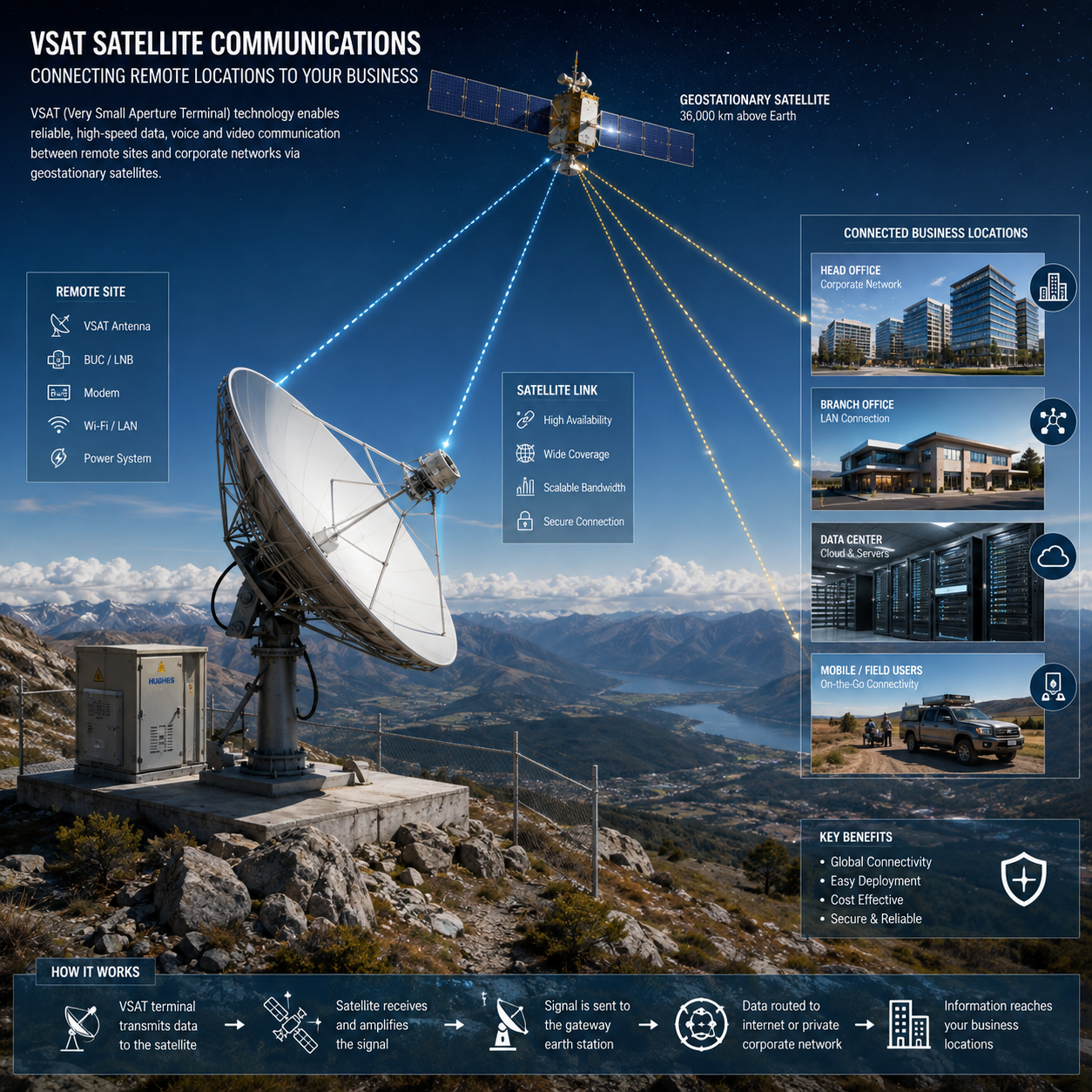
Very Small Aperture Terminal (VSAT) technology provides two-way voice, data, internet, and video communications through a satellite network. It is especially valuable where fiber, cable, or cellular service is unavailable, unreliable, or too slow to deploy.
A typical VSAT installation connects a remote site to a satellite, then routes traffic through a hub station or Network Operations Center (NOC). The result is a managed communications link for businesses, ships, aircraft, energy facilities, government agencies, banks, and emergency teams.
What Is VSAT Technology?
VSAT technology is a satellite communications system that uses a relatively small antenna to send and receive data through a satellite. A Very Small Aperture Terminal can support two-way satellite internet, corporate networking, voice calls, video, telemetry, and private data services.
The term refers to the remote terminal rather than a particular satellite, provider, or orbit. Many VSAT networks use a Geostationary Earth Orbit (GEO) satellite, which appears fixed over one region of Earth and can serve a wide geographic footprint. Other satellite architectures may also use compact terminals, so the orbit should be confirmed when comparing services.
In practical terms, VSAT extends a communications network beyond the reach of terrestrial infrastructure. A mine in a remote region, an offshore vessel, or a rural health clinic can connect to applications hosted at a company headquarters or cloud data center without waiting for a new fiber route.
VSAT systems may operate as managed business networks, internet access services, backup links, or private communications platforms. The terminal can carry several services over one connection, although available capacity must be planned carefully.
How Does a VSAT System Work?
A VSAT system works by sending an uplink from a remote terminal to a satellite and returning a downlink through a hub station or network gateway. The hub or NOC manages traffic, authentication, monitoring, and the connection to the internet or private network.
- A user at the remote site requests a web page, cloud application, voice call, or business transaction.
- The satellite modem converts the digital traffic into a signal suitable for satellite transmission.
- The outdoor unit and antenna transmit the signal upward in an uplink to the satellite.
- The satellite receives and retransmits the signal toward a hub station or gateway.
- The hub connects the traffic to the internet, a corporate wide-area network, a data center, or another remote terminal.
- Return traffic follows the reverse path as a downlink to the VSAT antenna and local network.
In a hub-and-spoke design, remote terminals generally communicate through a central hub. A mesh architecture can allow terminals to exchange traffic more directly, which may reduce some routing steps but can increase network complexity and equipment requirements.
GEO satellite systems introduce noticeable latency because signals travel a long distance between Earth and orbit. A user may experience delays in interactive applications even when the connection has adequate bandwidth. Web browsing, email, cloud synchronization, and store-and-forward systems usually tolerate this better than highly interactive voice, gaming, or remote-control applications.
For a useful technical overview of satellite communications concepts, the satellite internet access reference on Wikipedia provides additional background. Service specifications still depend on the provider, satellite, gateway, terminal, and network design.
Key Components of a VSAT Network
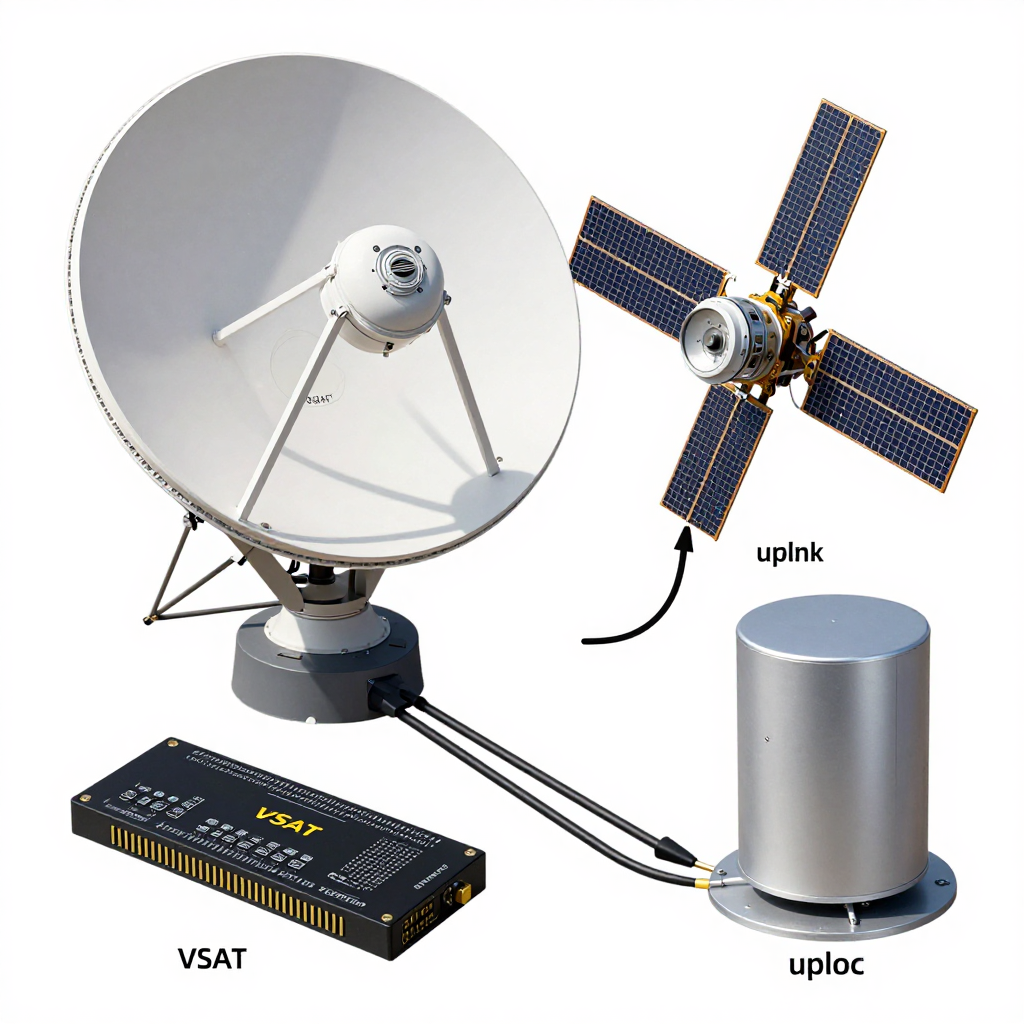
The main components of a VSAT network are the satellite dish and antenna, outdoor radio equipment, satellite modem, local network equipment, and hub infrastructure. Together, these components turn a remote site into a managed satellite communications endpoint.
Remote terminal equipment
- Satellite dish and antenna: Focuses radio-frequency energy toward the satellite and receives the returning signal. Antenna size varies according to frequency, link budget, location, and service requirements.
- Outdoor unit: Usually includes a block upconverter, low-noise block, feed assembly, and associated cabling. It transmits the uplink and amplifies or converts received signals.
- Satellite modem: Modulates outgoing data, demodulates incoming data, manages protocols, and may support traffic shaping, encryption, quality of service, and remote diagnostics.
- Indoor equipment: Routers, switches, firewalls, Wi-Fi access points, voice gateways, and application devices distribute connectivity across the site.
Hub and network-management infrastructure
The hub station or gateway aggregates traffic from many remote terminals. A Network Operations Center monitors terminal status, signal quality, capacity use, alarms, software updates, and service performance. Providers may also manage IP addressing, authentication, content filtering, routing, and security policies.
Installation requires an unobstructed view toward the satellite, a stable mounting structure, correct antenna pointing, grounding, weather protection, and a suitable power supply. In remote or harsh environments, backup batteries, generators, surge protection, and spare equipment can be as important as the dish itself.
Benefits of VSAT Connectivity
VSAT connectivity provides broad geographic reach, dependable remote access, and rapid deployment without requiring a terrestrial cable route. Its strongest value appears when location matters more than ultra-low latency.
- Coverage beyond terrestrial networks: A satellite footprint can serve isolated land sites, offshore platforms, ships, aircraft, and temporary operations.
- Network independence: VSAT can provide primary connectivity where fiber and cellular networks do not exist, or a backup path when local infrastructure fails.
- Rapid deployment: A transportable terminal can restore communications after a disaster or support a construction, exploration, or humanitarian project.
- Scalability: Organizations can connect many branches using a consistent architecture and centralized policies, subject to satellite capacity.
- Multiple services: One network may support internet access, voice over IP, video conferencing, point-of-sale traffic, telemetry, and corporate applications.
- Centralized management: A provider or NOC can monitor remote sites and apply network policies from a central location.
These benefits involve trade-offs. Choosing VSAT for geographic independence means accepting higher latency than most fiber or terrestrial broadband. Satellite capacity is also shared or engineered according to a service plan, so actual performance depends on contention, traffic patterns, and the contracted service level.
For organizations with strict uptime requirements, a useful design is hybrid connectivity: terrestrial broadband for everyday traffic, VSAT as a backup, and automatic failover through a managed router. The right arrangement depends on the cost of downtime and the availability of alternative networks.
Common VSAT Applications
VSAT is used wherever organizations need reliable communications beyond the practical reach of terrestrial infrastructure. Applications range from routine enterprise networking to emergency response and mobile operations.
Enterprise and institutional networking
Retail branches, banks, logistics depots, schools, clinics, and government offices can use VSAT to reach centralized applications. A private satellite network may carry point-of-sale transactions, inventory data, voice, security monitoring, and cloud traffic from locations without dependable broadband.
Maritime and aviation communications
Ships, offshore vessels, and aircraft use satellite connectivity for crew or passenger internet, operational data, weather information, electronic reporting, vessel monitoring, and communication with shore-based teams. Maritime and aviation installations must account for movement, antenna stabilization, regulatory requirements, and changing coverage areas.
Energy, mining, and industrial sites
Oil and gas facilities, mines, pipelines, renewable-energy sites, and remote utility installations often need connectivity for telemetry, supervisory systems, workforce communications, video, safety systems, and maintenance support. VSAT can link these sites before terrestrial infrastructure becomes economically practical.
Rural connectivity and public services
VSAT can connect rural communities, telemedicine facilities, emergency services, educational institutions, and public administration offices. It does not solve every affordability or local-distribution problem, but it can provide a backhaul link where terrestrial access is limited.
Disaster recovery and temporary sites
Emergency teams use portable VSAT terminals when earthquakes, floods, wildfires, or storms damage terrestrial networks. Construction camps, field hospitals, festivals, election operations, and temporary project sites can also use rapidly deployable satellite links.
VSAT Limitations and Important Considerations
VSAT performance depends on latency, weather, satellite capacity, installation quality, regulation, and network design. Evaluating these constraints before purchase prevents disappointing results and unexpected operating costs.
- Latency: GEO links can create delays that affect interactive voice, video collaboration, remote desktop use, and real-time control. Application acceleration and caching can help, but they cannot remove the physical distance.
- Weather disruption: Heavy rain, wet snow, and dense atmospheric conditions can weaken signals, particularly at higher frequencies. A larger antenna, appropriate link margin, and resilient service design may improve availability.
- Installation requirements: The site needs clear satellite visibility, secure mounting, grounding, power, and trained alignment. Trees, buildings, terrain, or later construction can block the signal.
- Bandwidth planning: A nominal speed does not guarantee unlimited capacity. Concurrent users, video traffic, backups, software updates, and cloud applications can quickly consume a service allowance.
- Cost structure: Equipment, professional installation, monthly capacity, support, transport, permits, and maintenance all affect total cost of ownership.
- Regulatory factors: Frequency licensing, landing rights, import rules, spectrum coordination, and country-specific approvals may apply.
- Cybersecurity: Satellite transmission does not automatically make traffic secure. Use firewalls, encryption, strong authentication, segmentation, patching, logging, and controlled modem administration.
A common mistake is choosing a plan based only on advertised bandwidth. Ask for committed information rates, contention policies, latency expectations, uptime definitions, restoration procedures, and usage limits. Another mistake is placing the dish where future vegetation or construction can obstruct the line of sight. A professional site survey is usually cheaper than relocating an installed terminal.
Is VSAT Right for Your Connectivity Needs?
VSAT is a strong option when coverage, independence, and availability at a remote site outweigh the disadvantages of latency and satellite capacity costs. It is less suitable when applications require consistently low delay or when high-capacity terrestrial service is already available at a reasonable price.
Use this six-part evaluation framework before selecting a service:
- Location: Confirm satellite coverage, line of sight, mounting space, power availability, and local regulatory requirements.
- Application sensitivity: Identify whether the site runs web applications, VoIP, video, telemetry, remote desktops, or real-time control. Test latency-sensitive workflows before deployment.
- Traffic volume: Estimate average and peak demand, number of users, cloud backups, video use, and seasonal changes. Include growth over the next three years.
- Availability target: Decide whether VSAT will serve as primary connectivity, a backup link, or an emergency-only system. Define acceptable restoration time and weather-related service thresholds.
- Operational conditions: Consider saltwater, dust, extreme temperatures, vibration, vehicle movement, physical security, and access for maintenance.
- Provider capability: Compare coverage, bandwidth, latency, service-level expectations, installation, NOC support, cybersecurity, equipment ownership, scalability, and cancellation terms.
For a remote mine with no fiber or cellular signal, VSAT may be the practical primary link. For a city office with fiber and 5G, it may make more sense as business continuity protection. For a ship or disaster-response team, the geographic flexibility can justify the additional cost and latency.
Ask prospective providers for a written link design, expected performance by location, antenna specifications, weather-availability assumptions, traffic-management rules, support escalation paths, and a complete installation quote. That evidence is more useful than a generic speed claim.
VSAT Technology FAQ
What does VSAT stand for?
VSAT stands for Very Small Aperture Terminal. It describes a compact satellite terminal used to send and receive communications through a satellite network.
How does VSAT internet work?
VSAT internet sends data from a satellite modem and antenna to a satellite through an uplink. The satellite forwards the signal to a hub or gateway, which connects it to the internet or a private network; return traffic follows the downlink path.
What is VSAT used for?
VSAT is used for remote connectivity, enterprise networking, maritime communications, aviation, banking, energy and mining, rural broadband, government services, disaster recovery, telemetry, voice, video, and temporary sites.
Is VSAT available in remote locations?
Yes, VSAT can serve many remote locations within a satellite’s coverage area, provided the site has a clear view of the satellite, suitable power, an approved installation, and a service plan with available capacity.
What is the difference between VSAT and satellite internet?
Satellite internet is the broader service category. VSAT refers specifically to the terminal and network architecture, often associated with managed business, institutional, and remote-site communications rather than only consumer broadband.